
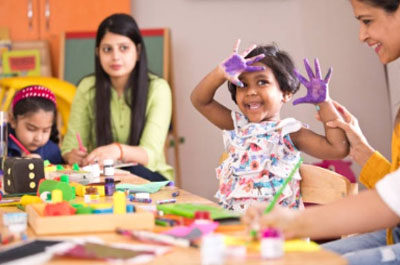
The early years are a time of rapid growth and discovery. Children are developing language, thinking skills, motor abilities, social relationships, independence, and an understanding of their emotions. Much of this learning happens naturally through play, everyday routines, relationships, exploration, and meaningful interactions with adults and other children. Play-based experiences, in particular, support cognitive, language, social-emotional, and self-regulation skills during early childhood (Yogman et al., 2018; NAEYC, 2020). These experiences form an important foundation for a child's transition into formal schooling.
When we think about school readiness, we often focus on whether a child knows the alphabet, can count, recognise colours and shapes, or write their name. While these skills are valuable, being ready for school is about much more than early academics. Contemporary early childhood frameworks view school readiness across multiple developmental domains, including physical, cognitive, language, social, and emotional development (Head Start, n.d.). A child also needs opportunities to develop communication, independence, attention, social skills, flexibility, and the ability to manage everyday emotions and experiences.
In the early years, children learn regulation through co-regulation. A responsive adult helps a child feel safe, names what they may be experiencing, provides predictable boundaries, and supports them in finding a way forward. Through repeated experiences within responsive relationships, children gradually become more able to manage emotions and behaviour independently (Head Start, n.d.; Yogman et al., 2018).
This becomes particularly important as children move into a school environment. Early schooling brings new routines, unfamiliar situations, group expectations, transitions between activities, and increased opportunities for social interaction. Children may be expected to wait for a turn, share materials, listen during group time, move from play to another activity, cope when something does not go as expected, and ask for help when they need it. These are not simply behavioural expectations, they are developmental skills that children are still learning.
When a child finds emotional regulation difficult, it can sometimes interfere with their ability to participate and learn. Self-regulation supports children's capacity to focus attention, manage impulses, shift between activities, and engage in goal-directed behaviour (Center on the Developing Child at Harvard University, n.d.). A child who becomes very frustrated when a task is challenging may give up rather than try another strategy. A child who finds transitions difficult may struggle to move from a preferred activity to a classroom task. Another child may become overwhelmed during peer conflicts and find it difficult to return to play. In these situations, the challenge may not be a lack of ability or willingness to learn; the child may need additional support to manage the emotional demands of the situation.
Emotional regulation also supports children's social development. Early classrooms are important spaces for learning how to make friends, take turns, negotiate, resolve small disagreements, and understand that others may have different needs and ideas. Play provides natural opportunities for children to practise cooperation, problem-solving, communication, self-regulation, and peer interaction (NAEYC, 2020; Yogman et al., 2018). Through play and guided interactions, children gradually learn to express their feelings, listen to others, cope with disappointment, and repair relationships after conflict.
From an Early Childhood Education perspective, therefore, school readiness should not be about expecting children to demonstrate perfect behaviour before they enter school. A child who is ready to learn may still cry when separating from a parent, become frustrated when something is difficult, or need adult support during a disagreement. What matters is that the child is developing the capacity to participate, communicate, adapt, and recover with appropriate support. Developmentally appropriate early childhood practice recognises children's individual developmental trajectories and emphasises strengths-based, play-based and responsive learning environments (NAEYC, 2020).
What Can Parents Do at Home?
Parents do not need to recreate a classroom at home to prepare their child for school. Everyday routines, relationships, and play provide rich opportunities to develop emotional regulation and school-readiness skills.
Create predictable routines
Regular routines around waking, meals, play, bedtime, and getting ready help children understand what to expect. Giving a simple warning such as, “Five more minutes of play, and then we will get ready for dinner,” can also make transitions easier.
Help children name their emotions
Use simple language such as, “You seem disappointed that the game is over,” or “You are frustrated because the puzzle is difficult.” Responsive adult-child interactions support children's developing ability to understand and manage their emotional experiences (Head Start, n.d.).
Give small, meaningful choices
Choices such as, “Would you like the red cup or the blue cup?” allow children to experience appropriate independence while adults continue to provide clear boundaries.
Allow manageable frustration
When a child finds something difficult, try not to immediately solve the problem for them. Instead, offer support: “It is tricky. What could we try?” or “Would you like a little help?” Children build self-regulation and executive functioning through repeated opportunities to practise skills with appropriate adult support (Center on the Developing Child at Harvard University, 2014).
Use play to practise social skills
Pretend play, simple board games, building activities, outdoor play, and everyday family interactions naturally provide opportunities to practise waiting, turn-taking, sharing, negotiating, problem-solving, and coping when things do not go exactly as planned. Play is recognised as a central context for children's learning and development in the early years (NAEYC, 2020; Yogman et al., 2018).
Build independence through everyday tasks
Encourage children to carry their belongings, put away toys, open their lunchbox, put on their shoes, or complete other age-appropriate responsibilities. Small opportunities for independence help children develop confidence and a growing sense of competence.
Model regulation
Children learn from watching the adults around them. Parents can model pausing, acknowledging frustration, solving problems, and using calm language. Saying, “I'm getting frustrated, so I'm going to slow down and try again,” gives children a concrete example of what managing emotions can look like.
The classroom environment also plays an important role. Developmentally appropriate expectations, consistent routines, opportunities for movement and play, warm adult-child relationships, and opportunities for choice can help children feel secure and ready to engage (NAEYC, 2020). Rather than asking only, “Is this child ready for school?”, early childhood educators can also ask, “How can we create an environment that is ready for this child?” This reflects the broader understanding of school readiness as a shared responsibility between children, families, and schools (Head Start, n.d.).
Every child develops at their own pace. Emotional outbursts, difficulty waiting, resistance to transitions, and occasional conflicts are a normal part of early childhood. However, when difficulties are persistent and significantly interfere with a child's participation, relationships, or learning, parents and educators can work together to better understand what the child may need.
Ultimately, school readiness is not simply about what children know before they enter school. It is about developing the foundations that enable them to engage, explore, communicate, connect, cope, and learn. Early Childhood Education plays a crucial role in building these foundations, not by rushing children into formal academics, but by creating rich, responsive and developmentally appropriate experiences through which children can become confident learners.